The manuscripts that predate Islam
What Christians in Arabia were actually reading in 610 AD, and how we know.
The argument's fourth premise is a historical claim, so it should be checked historically. The question is narrow and answerable: what did the Christian scriptures say in the decades before Muhammad began preaching, and how confident can we be about it?
The picture in 610 AD #
By the time Islam began, the New Testament had been circulating for roughly five hundred years. It had been copied into Greek majuscule codices, translated into Latin, Syriac, Coptic, Gothic, Armenian, Georgian and Ethiopic, quoted at enormous length by writers from Lyon to Alexandria, and read aloud weekly in churches from Britain to India. There was no central authority that could have coordinated a change across that spread, and by the seventh century several of those communities were no longer even in communication with each other.
The major witnesses #
- c. 125 AD Papyrus P52 A credit-card-sized fragment of John 18, containing part of Jesus' exchange with Pilate. Small, but it places the Fourth Gospel in provincial Egypt within a generation or two of its composition.
- c. 175–225 Papyrus 66 and Papyrus 75 Substantial portions of John, and of Luke and John together. P75's text is remarkably close to Vaticanus, written a century later — direct evidence that careful copying traditions existed early.
- c. 200 Papyrus 46 The earliest substantial collection of Paul's letters, including the whole of Romans and most of the Corinthian correspondence — with 1 Corinthians 15 and its creed about the death and resurrection of Christ.
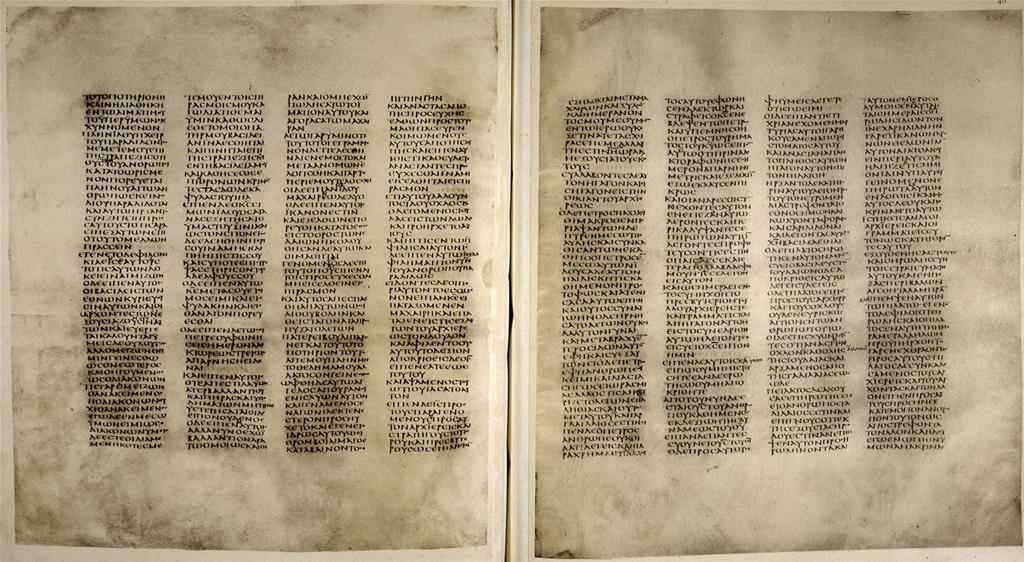
- c. 300–325 Codex Vaticanus Almost the entire Greek Bible in three columns per page. Held in the Vatican Library and fully digitised.
- c. 330–360 Codex Sinaiticus The oldest surviving complete New Testament. Discovered at Saint Catherine's Monastery in Sinai and now split between four institutions, which have reunited it page by page at codexsinaiticus.org — you can read the actual leaves online.
- c. 400–440 Codex Alexandrinus A near-complete Greek Bible in the British Library, produced probably in Egypt and later given to Charles I.
- 2nd–5th c. The versions The Syriac Peshitta, the Old Latin and then Jerome's Vulgate, the Coptic Sahidic and Bohairic, the Gothic of Ulfilas, and the Armenian. Translations made in different centuries, in different empires, from different exemplars — and they agree on the substance.
- 2nd–4th c. The quotations Irenaeus, Tertullian, Clement, Origen, Cyprian, Athanasius and others quote the New Testament so extensively that the text could be largely reconstructed from their works alone, independently of any manuscript.
How the dating works #
Manuscript dates are not guesses. They rest on palaeography — the way letter forms, ligatures and abbreviations changed over time, calibrated against documents that carry their own dates — together with the physical evidence of papyrus versus parchment, roll versus codex, ink chemistry, and in some cases radiocarbon analysis. Palaeographic ranges are usually given with a margin of fifty years or so, and specialists argue about individual cases. None of those arguments moves anything into the seventh century.
Where to look yourself
- The Codex Sinaiticus Project — transcription and translation beside high-resolution images of every leaf.
- Center for the Study of New Testament Manuscripts — a large open archive of manuscript photography.
- INTF Virtual Manuscript Room — the Münster institute's research tool, behind the Nestle-Aland editions.
- British Library digitised manuscripts — Alexandrinus among them.